
Last updated October 17, 2026
 Metal roofing
 Architectural shingles
 Tile roofing
 GAF
GAF Owens Corning
 Flat & low-slope
Free roof inspection with deck photos before we talk money - GAF and Owens Corning certified installation
Roofing Warning Signs: A Riverside Homeowner’s Reference Guide
Here’s a number that should get your attention: most roof failures in Riverside give homeowners between six and eighteen months of visible warning before a single drop of water lands on the living room floor. The problem is that our dry climate trains us to ignore those warnings. A cracked tile looks fine when it hasn’t rained since March. A rust ring around a nail head is easy to miss when you only go into the attic in December to grab Christmas decorations. This guide walks through every warning sign that matters in Riverside’s specific climate, what each one actually means, and the simple three-tier system we use to tell customers whether to monitor something, schedule a fix, or pick up the phone this week. For a deeper dive into local considerations, see our Complete Guide to Roofing in Riverside. You’ll leave knowing more about your roof than most homeowners ever do.
Quick Answer
The most common roof warning signs in Riverside are cracked or spalled tile (surface erosion that exposes the clay body underneath), granule loss from asphalt shingles collecting in gutters, rust around nail heads visible in the attic, and flashing separation at valleys, ridges, and penetrations. Riverside’s dry heat causes thermal expansion that concentrates cracking at ridge caps and valley flashing, and most of these problems show up months before any interior leak. The quick test: if you notice any of these signs, look inside the attic for damp insulation or rust rings around nails; if you see either, call a roofer this week rather than waiting for the next rain.
Styles & brands we work with
Table of Contents
- Tile Weathering vs. Erosion: What’s Normal and What’s Not
- Interior Warning Signs That Show Up Before the Ceiling Stain
- Why Riverside Heat Cracks Roofs at Specific Locations
- The Gutter Test: What Your Gutters Are Telling You
- The Three-Tier Triage System for Every Warning Sign
- Asphalt Shingle Warning Signs Specific to Riverside
- Flashing Warning Signs at Valleys, Chimneys, and Vents
- Common Mistakes to Avoid
Tile Weathering vs. Erosion: What’s Normal and What’s Not
Clay and concrete tile roofs are built to last 50 years or more, but that lifespan depends on the difference between weathering and erosion. Weathering is normal. Erosion is a warning sign. Here’s how to tell them apart from ground level or with a pair of binoculars.
Normal Weathering
Over decades, Riverside’s UV exposure slowly fades the surface color of tile. A brand-new terracotta tile has a uniform, saturated finish. Decades of sun strip that finish down to a chalky, lighter version of the original color. The surface stays smooth and intact. You might see hairline surface cracks no wider than a pencil line, but the tile itself remains solid. This is weathering. It’s cosmetic. It does not require replacement, and most tile roofs in Riverside’s older neighborhoods like Wood Streets, Canyon Crest, and Alessandro Heights show exactly this kind of fade without any structural problem underneath.
Erosion: The Replacement Indicator
Erosion is different. Erosion means the surface of the tile has begun to lose material, not just color. Look for these specific signs:
- Spalling: Thin flakes of tile surface, about the size of a fingernail or larger, have peeled away. The exposed body underneath is a different color (darker or more orange on clay, grayer on concrete) and has a rough, sandy texture.
- Deep cracking through the tile body: A crack that passes all the way through the tile, not just across the surface glaze. From the ground, hold binoculars at an angle and look for a dark line that interrupts the tile’s profile.
- Tile chips or corners missing along the eaves: When the bottom edge of a tile loses material, the underlayment beneath becomes exposed to UV, and that underlayment is not designed to handle direct sun for long.
- Discoloration streaks running down the roof slope: If white or gray streaks run vertically down a tile field, water has been getting under the tile surface and leaching minerals out of the tile body. This means moisture is already moving through places it shouldn’t.
Here’s the point: Riverside homeowners often wait until tiles slide off the roof before calling anyone. By then, the underlayment below those tiles has usually been exposed for years, and a full roof replacement often costs far more than it would have if the erosion had been caught at the spalling stage. The written inspection report we give every customer in Riverside includes photographs of both weathering and erosion so you can see exactly what we’re seeing.
Interior Warning Signs That Show Up Before the Ceiling Stain
Every homeowner knows the classic ceiling stain: a brown ring, usually after a rain, usually near a wall or fixture. But in our experience at Tilehurst Roofing Riverside, that stain is the late-stage signal. The roof has already been failing for months, sometimes years, by the time the stain appears. The earlier signs are in your attic. They’re just less obvious because most homeowners almost never go up there.
Here are the three interior warning signs that show up first, in order of appearance:
- Musty attic smell after warm days: Riverside gets long stretches of 90-plus degree days. Heat is exactly what activates mold and mildew spores in damp wood. If your attic has a sour, musty, or earthy smell on a hot day, something up there is holding moisture. The roof decking may have absorbed water during a past rain, or there may be a slow, active leak that evaporates between drizzles and never makes it to your ceiling. This smell is one of the first and most reliable early indicators.
- Insulation that feels damp to the touch: On a dry day, climb up and press your hand into the insulation near the eaves and around any vents. In Riverside’s normally dry climate, attic insulation should feel completely dry and crumbly. If it feels even slightly damp, cool, or clumped, water is getting in somewhere above it. Insulation retains moisture far longer than you’d expect, which means this sign can appear weeks after the last rain.
- Small rust rings around nail heads in the decking: This is the one competitors’ guides almost never mention. When a nail holding the roof decking or underlayment is exposed to moisture, the nail head rusts first. The rust spreads outward in a small ring around the nail shank. Run a flashlight beam across the underside of the decking and look for tiny orange or brown circles around nails. If you see five or more rust rings, moisture has been reaching the decking repeatedly. The source is often a cracked tile or a failed seal at a nail penetration in the underlayment above.
The reason Interior Riverside homes in particular show these signs: our low-humidity climate means water that does get into the attic dries fast. A leak that would produce a visible ceiling stain within a week in Florida might evaporate entirely in Riverside between storms. That’s why the musty smell, damp insulation, and rust rings matter so much here. They’re often the only signal you’ll get before a big storm overwhelms the drying capacity and the leak finally reaches the drywall.
Why Riverside Heat Cracks Roofs at Specific Locations
Roof materials expand and contract with temperature changes. Every material does this, from clay tile to metal flashing to asphalt shingles. What makes Riverside unusual is the combination of intense daytime heat and rapid evening cooling. A roof surface in Riverside can swing 60 degrees or more between a July afternoon and that same night. Over years, that repeated expansion and contraction acts like a slow, patient crowbar working at the seams of the roof.
Three specific locations in Riverside carry this thermal stress most intensely:
Ridge Caps
The ridge cap is the rounded or angled row of tiles that runs along the peak of the roof where two slopes meet. Ridge caps sit at the highest point of the roof, which means they get the most direct sun and the most extreme temperature swings. The mortar or adhesive that holds ridge caps in place loses its bond over time as the cap tile expands away from the roof deck. From ground level, look at the ridge line. Do any cap tiles look slightly lifted, shifted, or misaligned? A hairline gap at the ridge cap is often the first visible sign of thermal fatigue. Left alone, that gap widens, and wind-driven rain enters directly at the highest point of the roof.
Valleys
A valley is the V-shaped channel where two roof slopes come together, usually over an interior corner of the home. Valleys channel more water than any other part of the roof, and in Riverside, they also carry significant thermal expansion stress because the two slopes expand toward each other unevenly. The metal flashing that lines most valleys in Riverside home styles (L-shaped valley flashing or open valley metal) develops hairline fractures along its bend line over time. From the ground, look for a dark vertical line running down the center of the valley, or for the metal to appear wavy rather than straight. A cracked valley flashing sends water under the roofing material instead of down the valley.
Penetration Flashings
Every pipe, vent, skylight, and HVAC unit that passes through the roof gets a flashing collar around it. These flashings are typically made of rubber, neoprene, or metal, and they sit flat against the hot roof surface all day. Rubber and neoprene flashings degrade under Riverside’s UV exposure faster than the roof field around them. The degradation shows up as cracking at the base of the boot or tearing around the clamp band. If a pipe boot flashing splits, water drips straight down the pipe and into the attic. Many homeowners never see this because the penetration is often on a back slope or behind a wall. In our inspections, we check every penetration flashing on every roof we look at, regardless of whether the homeowner has noticed anything wrong.
The practical takeaway: if you see any crack pattern forming along the ridge, in a valley, or near a pipe boot, that crack is thermal fatigue, not a single-impact event. A cracked ridge cap from thermal movement is never the only one. There are almost certainly two or three more beginning to form elsewhere on the same roof.
The Gutter Test: What Your Gutters Are Telling You
Gutters are the most honest reporting system a roof has. Everything the roof loses eventually ends up there, and what you find tells you exactly what’s happening on the slopes above. This test takes ten minutes and requires no ladder work beyond what you’re comfortable with. Use a pair of rubber gloves, or run the test from a stepladder at one end of the gutter rather than walking the roofline.
What to Look For
Clean out a one-foot section of gutter, ideally near a downspout, and examine what’s collected there. Then compare it to this list:
- Lots of fine, dark granules that look like coarse sand, especially heavy after rain: This is asphalt shingle granule loss, and it’s normal in small amounts during a roof’s first year or two. After year five, heavy granule loss in the gutter is the single clearest sign your shingles are losing their protective UV layer. In Riverside, where UV is relentless, granule loss progresses faster than in cloudier climates. This is a monitor-it sign that becomes schedule-it when the granules start to outnumber the leaf debris.
- Small pieces of clay or tile, flat and no larger than a quarter: This is spalling material from a tile roof, and it means erosion has started on the field tiles. Combined with the visual signs of spalling described above, this moves the roof into schedule-it territory.
- Chunks of mortar or cement, especially if your home has a mission or Spanish tile style with mortared ridges: The mortar holding ridge caps is breaking down. This is a call-this-week sign, because a loose ridge cap lets water into the attic even when the field tiles below are intact.
- Rusted metal flakes or small strips of metal flashing: A flashing component somewhere is failing, likely at a valley or penetration. Metal flashing doesn’t rust and flake unless moisture has been sitting against it for a long time. This is a call-this-week sign.
- Nothing but fine dust and an occasional leaf: This is the normal baseline for a healthy roof in Riverside’s dry months. A roof that sheds only dust and leaf litter is doing its job.
The best time to run the gutter test is in late October or early November, before winter rain arrives. That gives you a clear picture of what the dry season has done to the roof and still leaves time to schedule repairs before the first hard rain. We recommend running it again in March after the rainy season ends, as a second data point. Some of our customers in the Hawarden Hills and Mission Grove neighborhoods do this every spring and fall; it’s the lowest-cost roof inspection you’ll ever perform.
The Three-Tier Triage System for Every Warning Sign
One of the most common questions we hear is some version of: “I noticed [something on the roof]. How urgent is it?” The honest answer is that urgency depends on which warning sign you’re seeing and where it sits on the roof. Not every cracked tile needs a crew out next week. Not every missing granule means a replacement. Here’s the three-tier system we use with our own customers in Riverside to tell exactly how urgent any given sign is.
Tier 1: Monitor It
Recheck after the next rain or in 60-90 days. No scheduling needed yet.
- Light granule loss in gutters on a roof under five years old
- Normal tile weathering (faded or chalky surface, intact tile body)
- A single hairline crack in one tile, no wider than a pencil line
- Minor surface oxidation on a pipe boot, with no visible split
Take a photo with your phone every time you check. The comparison over time is what tells you whether the issue is stable or progressing.
Tier 2: Schedule Within 90 Days
Call and book a repair in the next three months, before the next heavy rain stretch.
- Spalling on multiple tiles in one area, with exposed tile body visible
- Granule loss heavy enough that dark shingle spots are visible from ground level
- Rust rings around nails in the decking, visible from the attic
- Mortar loss on ridge caps, with one or two caps visibly shifted
- Valley flashing that appears wavy or darkened along the bend line
- Musty attic smell that returns on warm days
These signs mean the roof’s protective layers are compromised but not yet failed. The repair is still contained. Wait too long and the fix expands from a ridge cap replacement to a full section of roofline.
Tier 3: Call This Week
Pick up the phone and call us at (562) 315-0297. Don’t wait for the next rain.
- Any visible daylight through the roof decking when viewed from the attic
- Damp insulation or a visible drip anywhere inside the attic
- Cracked valley flashing with dark staining around the crack
- Ridge caps that have lifted enough for wind to catch the edge
- More than five rust-ringed nails clustered in one area of the decking
- A brown ceiling stain that has already appeared inside the living space
The guiding principle: water entry is always Tier 3. If moisture is reaching the decking, the damage compounds daily, whether it rains or not. Mold growth, decking rot, and insulation degradation all continue after the water source stops. The cheapest day to fix a Tier 3 roof is the day you discover it.
See the difference
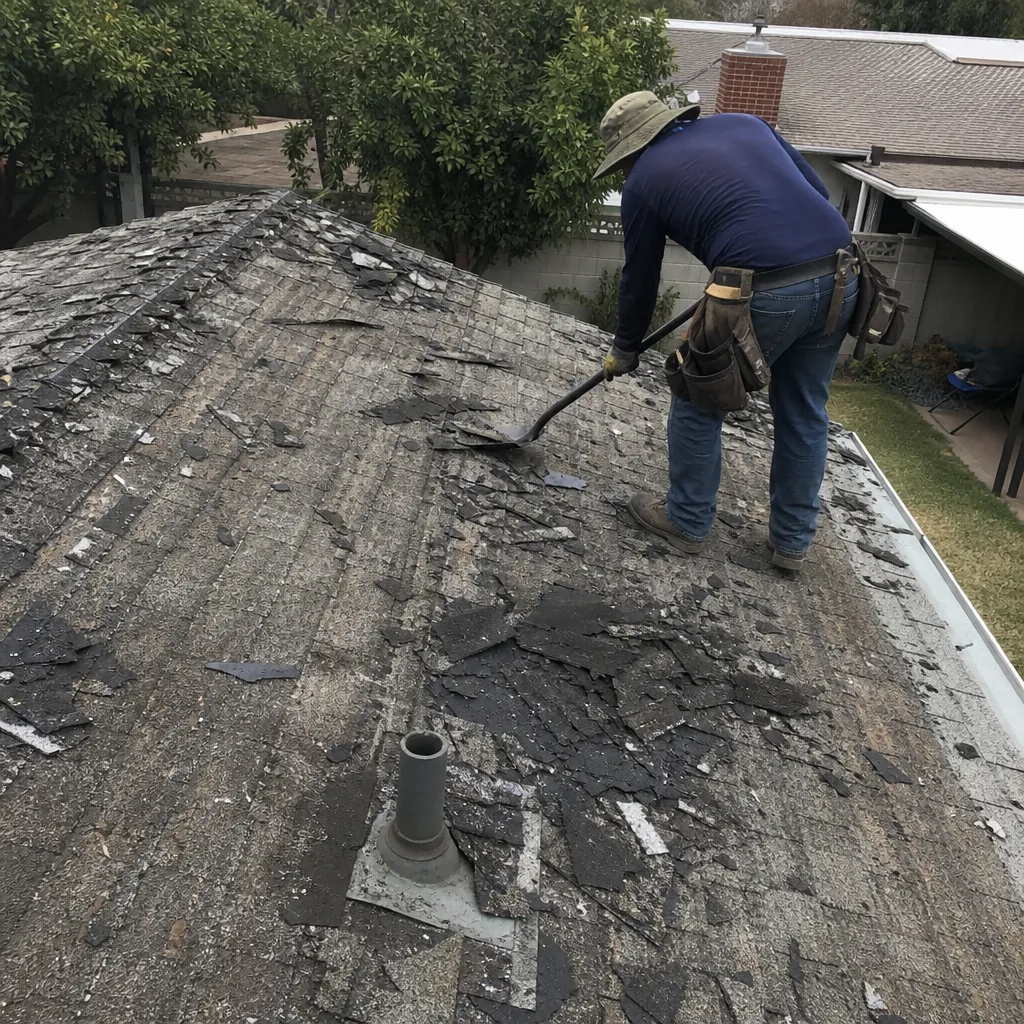 Before
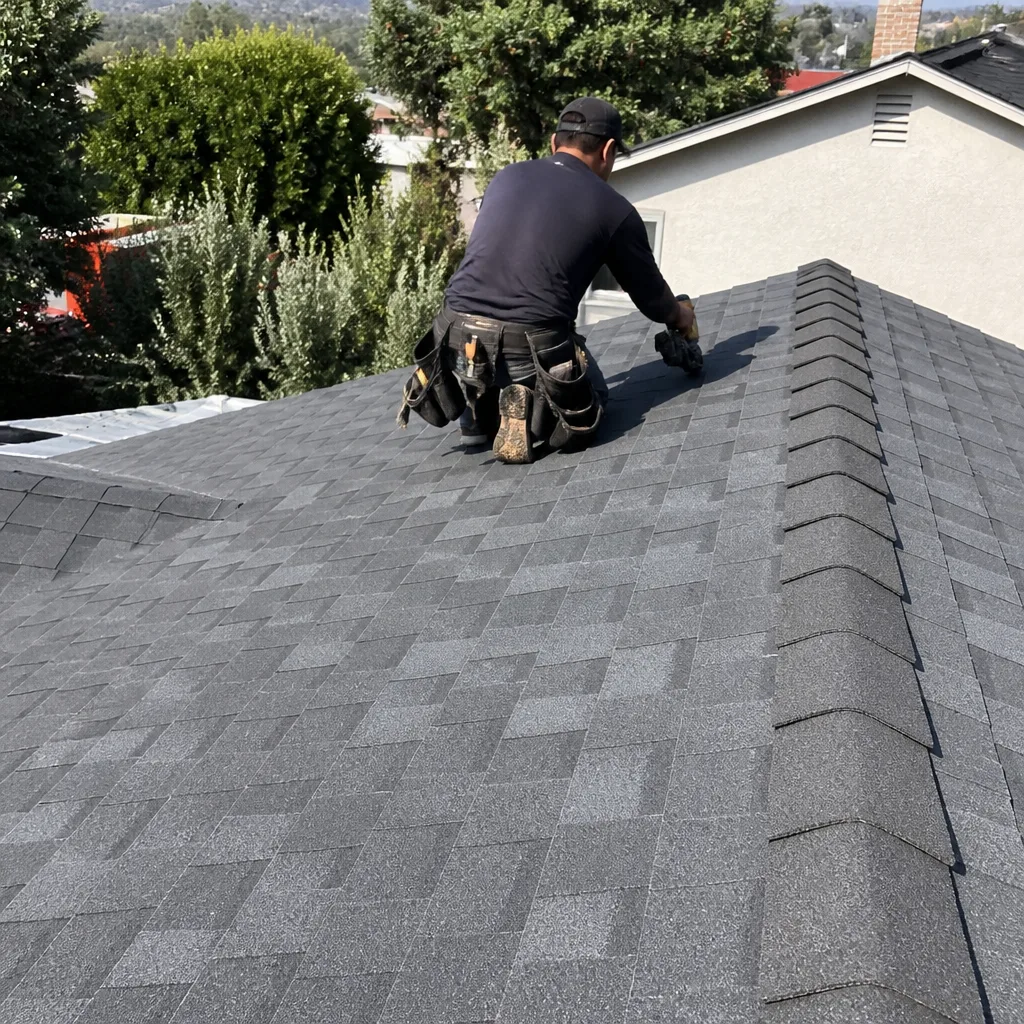 After
After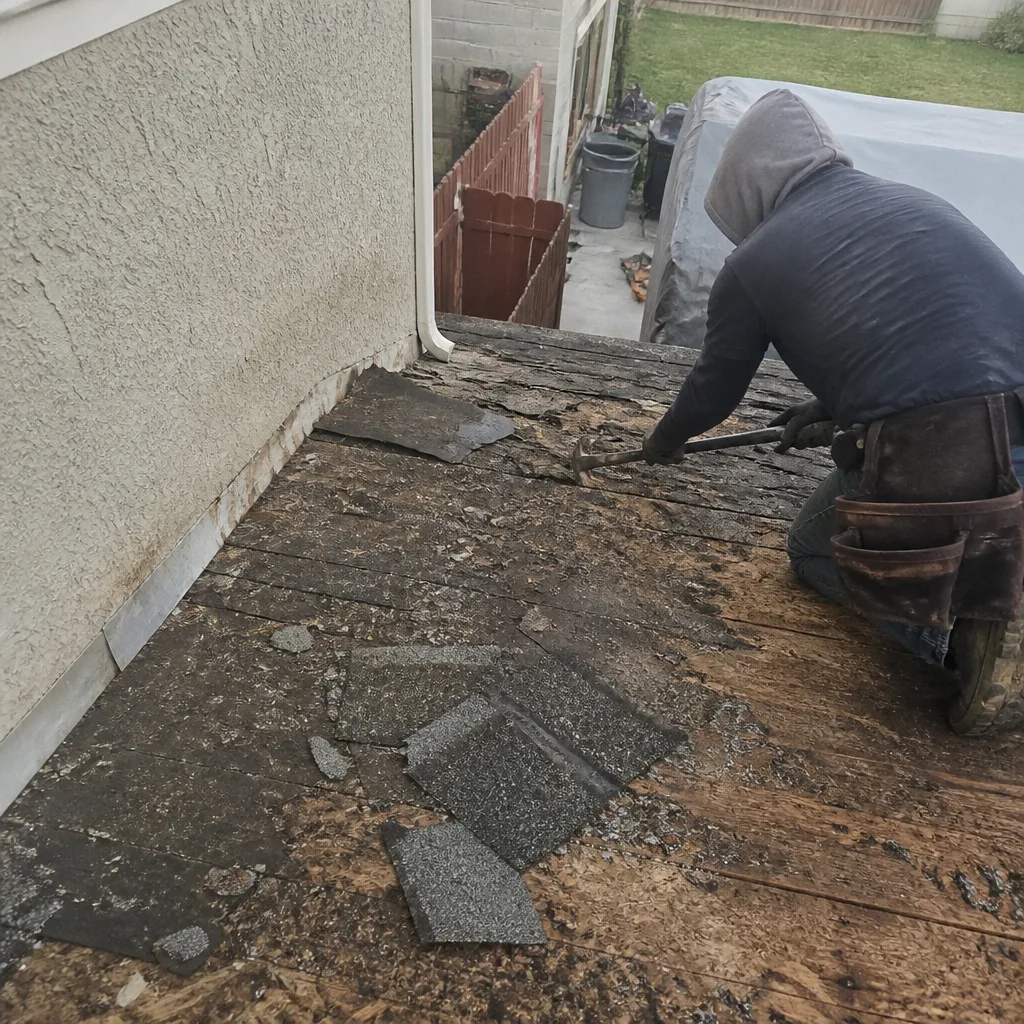 Before
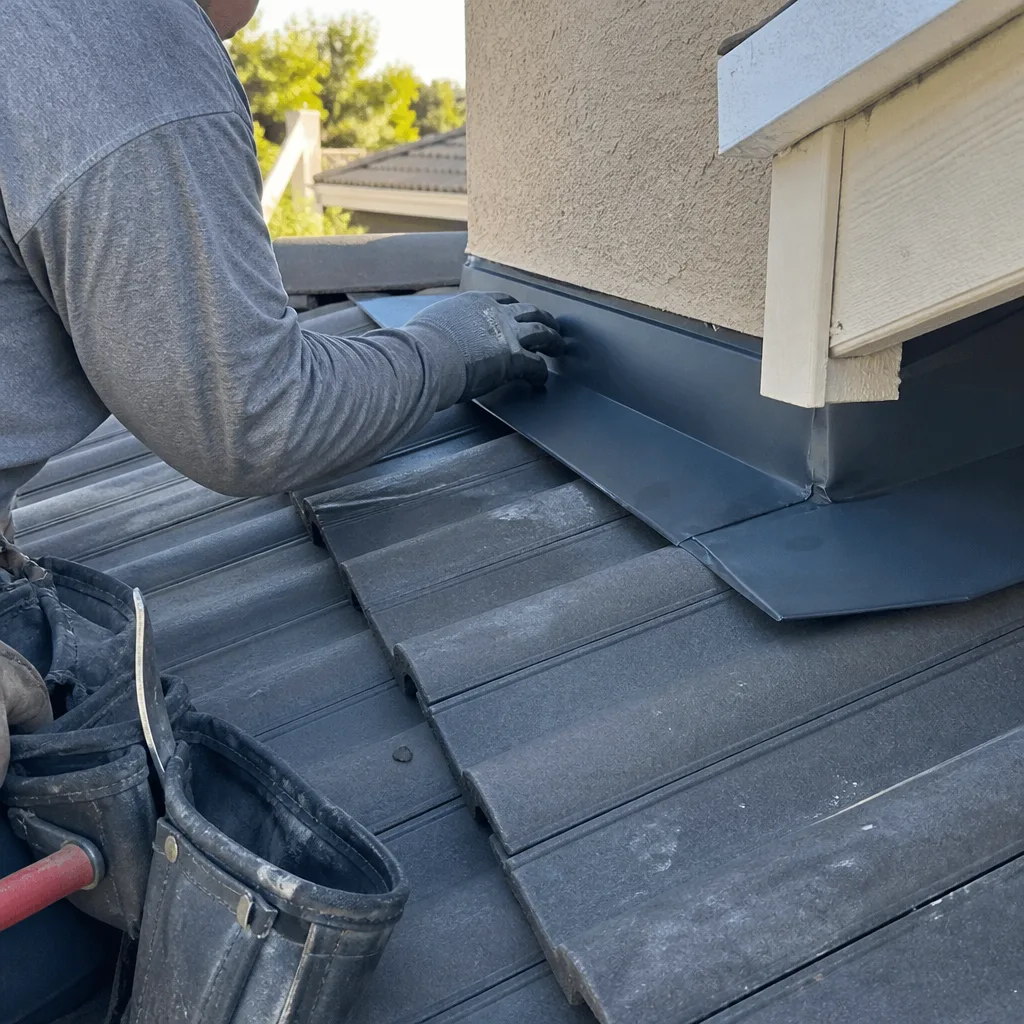 After
After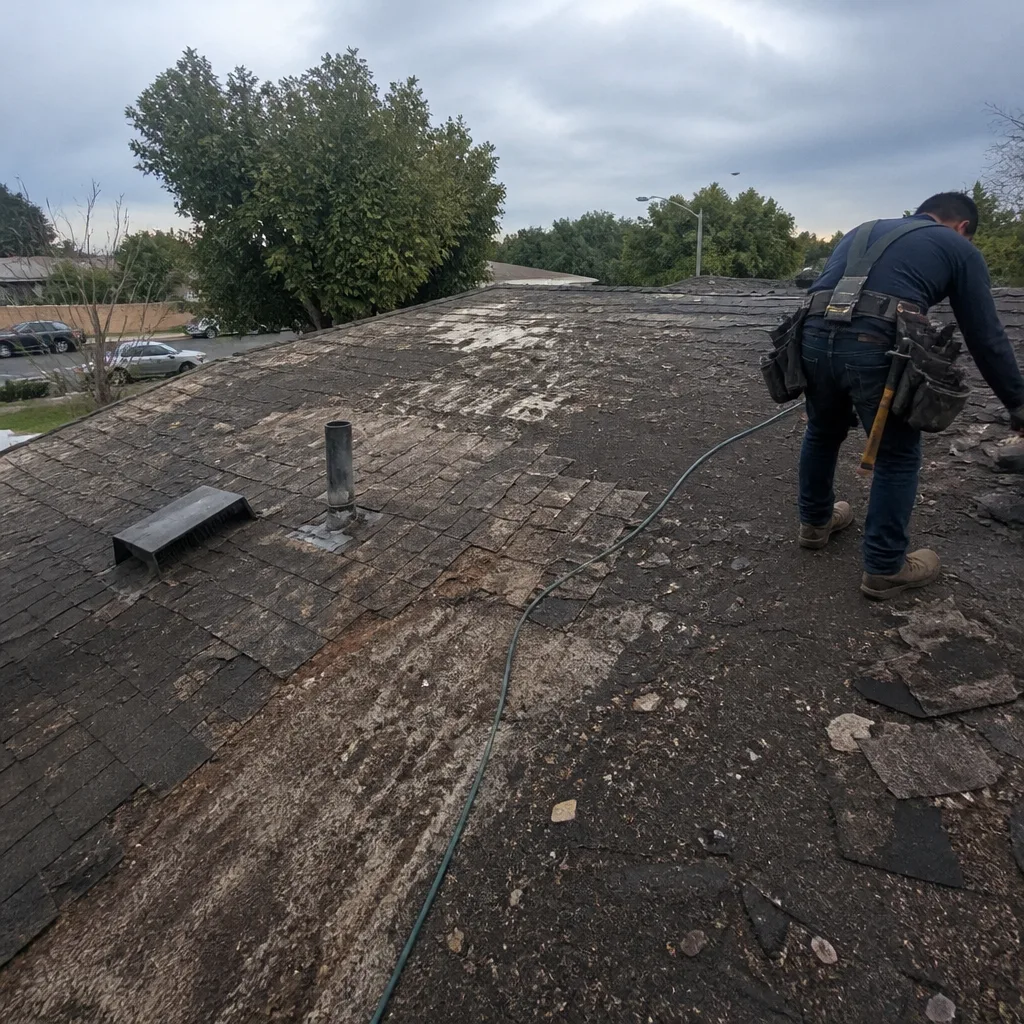 Before
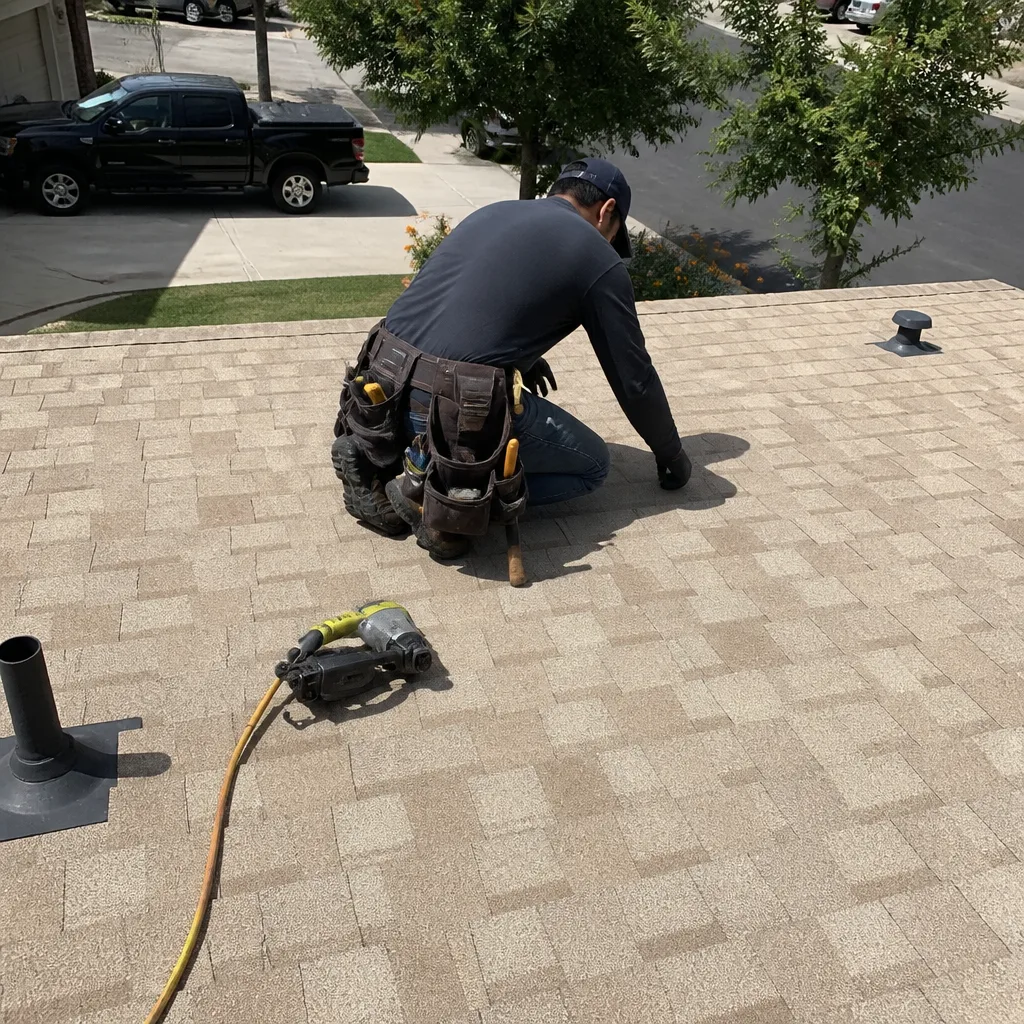 After
AfterAsphalt Shingle Warning Signs Specific to Riverside
Asphalt shingles dominate much of Riverside’s newer housing stock: the master-planned communities around Orangecrest, the Mission Grove hillsides, and the tract developments that fill the gaps between older neighborhoods. Shingles don’t fail the same way tile does, and Riverside’s heat puts them under a different kind of stress than homeowners in cooler climates experience.
UV Blistering and Premature Aging
Riverside’s UV index runs high for most of the year. A 20-year asphalt shingle in Seattle might still be serviceable at year 20. In Riverside, that same shingle is often spent by year 15. The specific warning sign is blistering: small, raised bumps on the shingle surface where the asphalt has expanded and released gas bubbles. Blistered shingles lose granules faster, crack more easily, and absorb more heat than intact ones. If you see blistering across a wide area of the roof from ground level (it looks like uneven, pimpled texture instead of a uniform granule surface), the shingle system has aged beyond its practical midpoint.
Cupping and Curling at Edges
Shingle edges should lie flat against the roof. In Riverside, the prolonged heat causes the corners of shingles to curl upward, a condition roofers call cupping. Curling shingles catch wind, making them vulnerable to tearing in Santa Ana conditions, and they expose the sealant strip between each shingle layer. When the sealant strip is exposed to UV, it degrades, and the next shingle layer begins to slip. This is a schedule-within-90-days sign when it appears on ten or more shingles.
What Shingle Brands We Install and Why It Matters
One thing Riverside homeowners should know: shingle choice matters more in our climate than it does somewhere milder. We install asphalt shingles from CertainTeed, Owens Corning, GAF, IKO, Atlas, Tamko, and Boral depending on what the home needs and what the homeowner wants to invest in. The right shingle for a Riverside home is not necessarily the same shingle that works in Chicago or Portland. Some shingle lines are rated for high-heat performance and hold their granules longer under sustained UV. We walk through the options on every Roof Replacement in Riverside estimate so the shingle you’re buying is matched to our climate, not just to what happens to be in stock.
Flashing Warning Signs at Valleys, Chimneys, and Vents
Flashing is the unsung component of any roof system. It’s the metal, rubber, or plastic material that bridges the gaps between the roof and anything that protrudes through it: chimneys, vents, pipes, skylights, and walls. Flashing almost never gets the credit it deserves, and when it fails, the leak it causes is often blamed on the shingles or tiles around it. Here’s what to look for at each location.
Chimney Flashing
Masonry chimneys are common in Riverside’s older neighborhoods, particularly in the ranch and Spanish Colonial styles in Wood Streets and Victoria. The flashing around a chimney consists of two parts: the step flashing that runs up the chimney sides and the counter-flashing that’s set into the masonry. Over time, the sealant between these two parts fails, and the metal itself can pull away from the brick as the chimney settles. The warning sign is a visible gap between the flashing and the brick, or sealant that’s cracked into small, dry chunks. On a brick chimney, also check for spalling brick face around the flashing line; that indicates repeated moisture saturation behind the flashing.
Pipe and Vent Boots
Every plumbing vent, bathroom exhaust, and kitchen hood vent gets a flexible boot around the pipe where it exits the roof. These boots have a service life of roughly 10-15 years in Riverside’s heat, which is considerably shorter than the 30-year shingle or 50-year tile around them. The warning signs: visible cracks or splits in the rubber, a boot that has lost its grip on the pipe and sits loose, or a boot with the flat base curling up at the edges. If you’re already up in the attic for the rust-ring check, shine a flashlight up at the pipe penetrations. You can often see light or moisture around the pipe base before you can see any problem from the roof side.
Wall and Skylight Flashings
Where a roof slope meets a vertical wall, a metal or rubber apron flashing covers the junction. In Riverside, the expansion of the roof decking against the wall pushes and pulls at this junction constantly. The early warning sign is a horizontal crack in the stucco or siding just above the roofline, which means the flashing beneath it has shifted. Skylight flashings are similarly prone to the same thermal stress, and the failure is usually at the seal between the skylight frame and the roof surface. Check your skylight from the inside on a sunny day: if you see white caulking around the inside edge that looks cracked or yellowed, water has been getting past the exterior flashing and wicking inward.
If any of these flashing conditions sound familiar, the fix is usually contained to the flashing itself rather than the roof field. That makes it one of the more affordable repairs we do. Every Roof Repair in Riverside we perform comes with a written guarantee; if the repair fails inside the guarantee period, our crew comes back and corrects it at no charge. That guarantee is part of how we’ve always worked under the Kingswell Way: say the price before the work, show up in the window we gave, put the guarantee in writing, and come back if it fails.
Common Mistakes to Avoid
- Assuming dry weather means the roof is fine: Riverside’s dry climate is exactly what hides slow leaks. A roof can be failing for a year and show no interior sign because the water evaporates before it stains anything. Check the attic and gutters even during dry stretches.
- Replacing one cracked tile without checking the underlayment beneath it: The tile is the visible surface, but the real waterproofing layer is the underlayment. If water got under that cracked tile, the underlayment may already be compromised. Replacing the tile alone just hides the problem again.
- Using exterior silicone caulk to patch a flashing leak: Silicone caulk from a hardware store is a temporary bandage, not a repair. In Riverside’s heat, it dries, cracks, and peels within a season or two. The flashing needs to be properly reset or replaced, which a professional roofer does with materials rated for roof-level UV exposure.
- Waiting for the ceiling stain before calling anyone: By the time water reaches the drywall, the repair has expanded to include insulation, decking, and likely mold remediation. Early attic signs like rust rings and damp insulation catch the problem when it’s still a $300 flashing repair instead of a $3,000 drywall and decking job.
- Ignoring gutter granules because “it’s an old roof anyway”: Old does not equal done. A roof loses most of its protective capacity in the final third of its life, and granule loss is the gauge that tells you where you are on that curve. Running the gutter test twice a year gives you a baseline to measure against.
- Assuming a new roof means zero maintenance for 30 years: Even a newly installed roof in Riverside should be checked after major Santa Ana wind events. Wind-blown debris can crack a tile or lift a shingle corner, and the damage compounds quietly from there. An annual visual check is cheap insurance on a new roof.
- Choosing a roofer based only on the lowest quote: The cheapest bid in Riverside often comes from a crew that won’t be around in six months when the repair fails. The Kingswell Way exists because homeowners told us over and over that the pain wasn’t the first roof repair; it was the second one on the same spot.
For a full overview of how we work and what we check on every roof, see our Roofing Company in Riverside page.
When to Call a Professional
You don’t need to climb onto your roof. You need someone who knows exactly what to look for from the ridge to the gutter. Call a professional roofer in Riverside when you see any Tier 2 or Tier 3 warning sign from the triage list above, when your gutter test finds granule or mortar accumulation, when attic inspection reveals rust rings or damp insulation, or when you notice any crack pattern along a ridge, valley, or penetration. These conditions rarely self-correct. The longer they sit, the more the repair expands beyond the original point of failure.
If you’re in Riverside and want a trained eye on the roof without any obligation, Tilehurst Roofing Riverside offers free estimates throughout the city. We’ll give you a written report with photos, a written price if any work is needed, and our written guarantee on any repair. Call (562) 315-0297 to schedule. A live person answers, day or night.
Frequently Asked Questions
Most asphalt-shingle repairs in Riverside run between $350 and $900, while tile roof repairs typically land between $500 and $1,500 depending on how many tiles, whether the underlayment beneath needs patching, and whether the repair is at a simple field location or a more complex junction like a valley or ridge. Flashing repairs around a pipe or vent commonly run $250 to $600. We give the written price before any work starts, so you never get a surprise at the door. Call (562) 315-0297 for an exact quote; the estimate is free.
Most minor leaks from a failed pipe boot, cracked tile, or separated flashing can be repaired in a single visit as long as the decking beneath is not saturated. If decking has been wet for a long time, the repair may need a second day to allow for drying and deck replacement. We’ll tell you which category your roof falls into after the inspection, with a written price before any work begins.
No. The written price you receive before any work begins is the price, period. Our no-hassle upfront pricing is part of the Kingswell Way and a direct answer to the no-show, price-at-the-door experiences that too many Riverside homeowners have had. Occasionally an inspection uncovers hidden decking damage that wasn’t visible before the old roof was opened up, but in those cases we stop, show you what we found, and get your written approval before doing anything beyond the original scope.
A typical single-story asphalt-shingle roof replacement in Riverside takes two to four working days. A tile roof replacement usually takes five to eight working days because of the additional setting and mortaring work. Weather, roof complexity, and the tear-off condition of the existing decking can all shift those numbers, and we’ll give you a written timeline as part of the estimate.
Yes. Any roof replacement in Riverside requires a permit from the City of Riverside, and we handle that as part of the job. Repairs that don’t involve structural changes typically don’t require a permit, and we’ll tell you in writing which category your project falls into. Permits protect you: they mean the work is inspected by the city and has to meet code.
We install materials from seven leading manufacturers: GAF, CertainTeed, Owens Corning, IKO, Atlas, Tamko, and Boral. That means your roof gets the product that fits your home’s style, slope, and budget, not just whichever line happens to be on the truck. Specific brands like CertainTeed, Owens Corning, IKO, and Atlas are common choices for Riverside homes because of their heat and UV resistance profiles. We’ll show you samples and walk through the differences before you commit to anything. You can also explore more guides & resources on our blog anytime.
The Bottom Line
Riverside’s climate gives every homeowner a long runway to catch roof problems before they become disasters, but only if they know what to look for. Tile erosion looks different from tile weathering. Rust rings in the attic precede ceiling stains by months. The gutter test tells you more about your roof’s remaining lifespan than any marketing brochure ever will. And the three-tier triage system turns a confusing list of symptoms into a clear action plan: monitor, schedule within 90 days, or call this week. If you find anything from Tier 2 or Tier 3 during your next check, get a written estimate from a roofer who will put the price and the guarantee on paper. Then you’ll know exactly where you stand and exactly what it costs to fix. Back to the Tilehurst Roofing Riverside home page.
Written by Greg Holloway, Owner at Tilehurst Roofing Riverside, serving Riverside since 2000.